McDonald's selected Aira to solve the accessibility issue for Deaf and Hard of Hearing (DHH) users in the drive-thru.
Research & Design
Project Overview
Client: McDonald's
Industry: Multi-National Quick Service Restaurant
Timeline: 10 weeks (2025)
My Role: User Researcher
The drive thru experience is designed primarily for hearing customers, creating a significant accessibility gap for the Deaf community. While hearing customers enjoy a streamlined process, Deaf customers often face friction and communication breakdowns.
For this 10-week pilot project, our objective was to determine if introducing a personal ASL interpreter through Aira could elevate the Deaf customer experience to a level of quality and ease comparable to that of hearing customers. Ultimately, this research led to a report-out to the McDonald's C-Suite.
Skills
Core Methodologies
Field Studies (In-Environment Testing)
Longitudinal Studies (Pilot Program)
User Journey Mapping
Design & Prototyping
UI Design
Wireframing
Onboarding Flow Design
High-Fidelity Prototyping
Domain Knowledge
Deaf Culture & Communication
Service Design
Physical/Digital Hybrid Experiences
Results
Our research revealed a complex user journey. While the introduction of the technology initially caused friction, it ultimately led to a superior experience once users overcame the learning curve.
The "Learning Curve" Dip:
Baseline (No App): Users rated their standard drive-through experience a 4/5 (Slightly Positive).
First Use (With App): Satisfaction plummeted to 1/2 out of 5.
Second Use (With App): Satisfaction rebounded and exceeded the baseline, reaching a 5/5 (Excellent).
By analyzing the friction points that caused the initial drop in satisfaction, I identified that users needed better preparation before entering the drive-through. I designed high-fidelity UI mockups specifically aimed at onboarding users and mitigating the physical and cognitive load of the "first-time" experience.
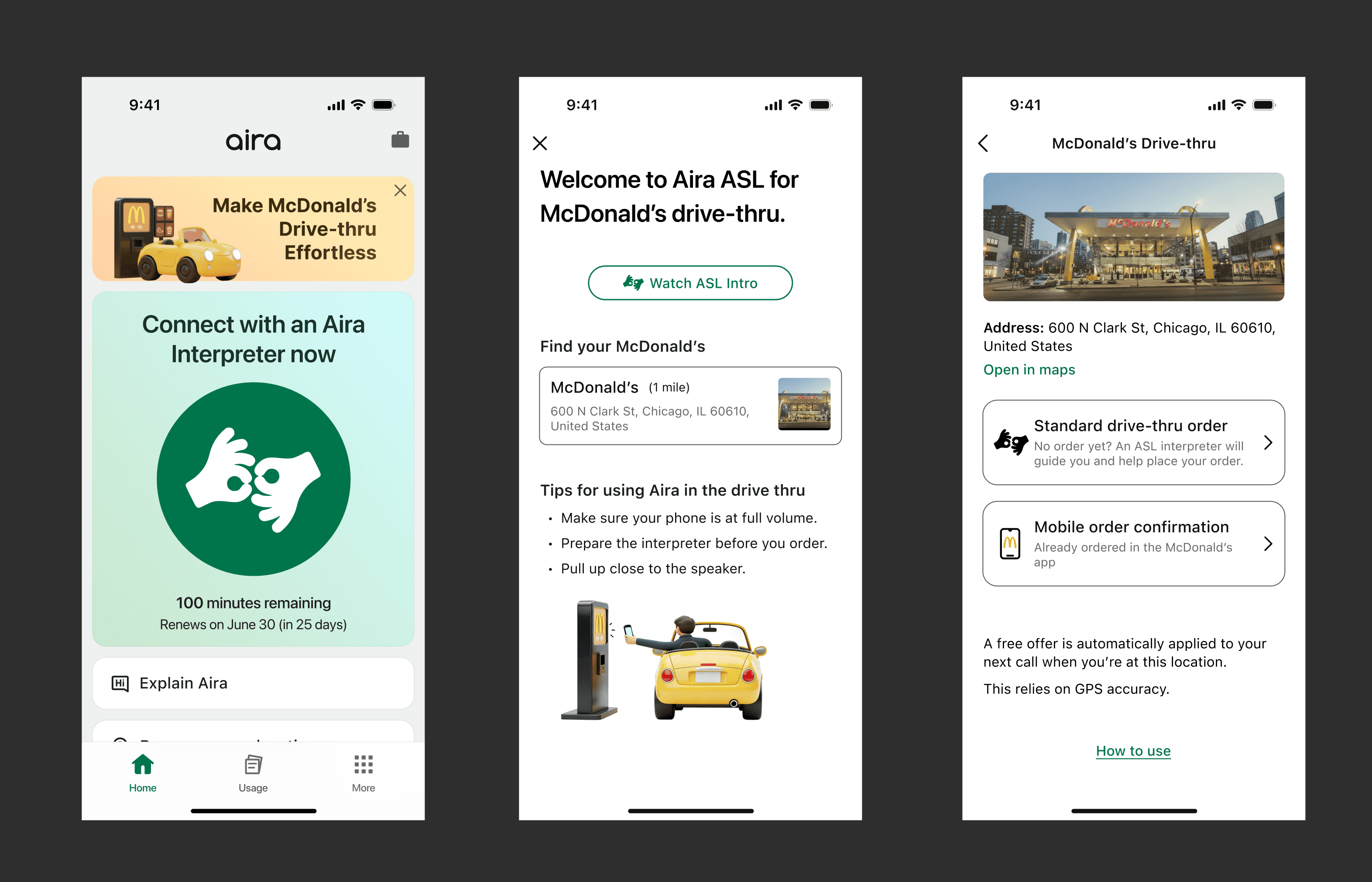
The final design for the UI mockups.
Process & Insights
We conducted live user testing in McDonald's drive-throughs to observe the intersection of the digital app experience and the physical environment.
Identifying Hardware Constraints: We discovered that McDonald's speaker systems have inconsistent and often low sound quality. This made it difficult to guarantee a seamless audio connection for the remote interpreter, identifying a hardware constraint we had to design around.
Uncovering Ergonomic Friction: The sharp drop in satisfaction during the First Use phase was not due to the interpreter service itself, but due to physical multitasking. Users were not accustomed to:
Holding a phone while steering.
Positioning the phone microphone near the car window.
Retrieving food while maintaining the connection.
The Design Pivot: We realized the "learning curve" was the primary barrier. Once users understood the choreography of the interaction (by their second attempt), the experience was rated higher than a standard visit.
Solution: To bridge this gap, I worked with our UX designer to design a UI flow that preps the user before they reach the speaker. These designs guide the user on phone placement and what to expect, effectively flattening the learning curve and aiming for that 5/5 experience on the very first try.
Opportunities for Improvement and Expansion
If given more time and resources, the focus would shift more to quantitative metrics to ensure a business-buy-in.
Implement Low-Fidelity Audio Testing. The primary constraint was the inconsistent sound quality of McDonald’s speakers. A dedicated phase would involve testing various noise-canceling microphones or directional audio devices that could be temporarily installed near the speaker upon activation of the interpreter service. This moves beyond merely designing the app interface and tackles the physical environment friction.
Longitudinal Study on Staff Impact. The current study focused on the customer. Future research would analyze the impact on McDonald's staff, measuring changes in order accuracy, transaction time, and employee stress levels when interacting with customers using the interpreter service.