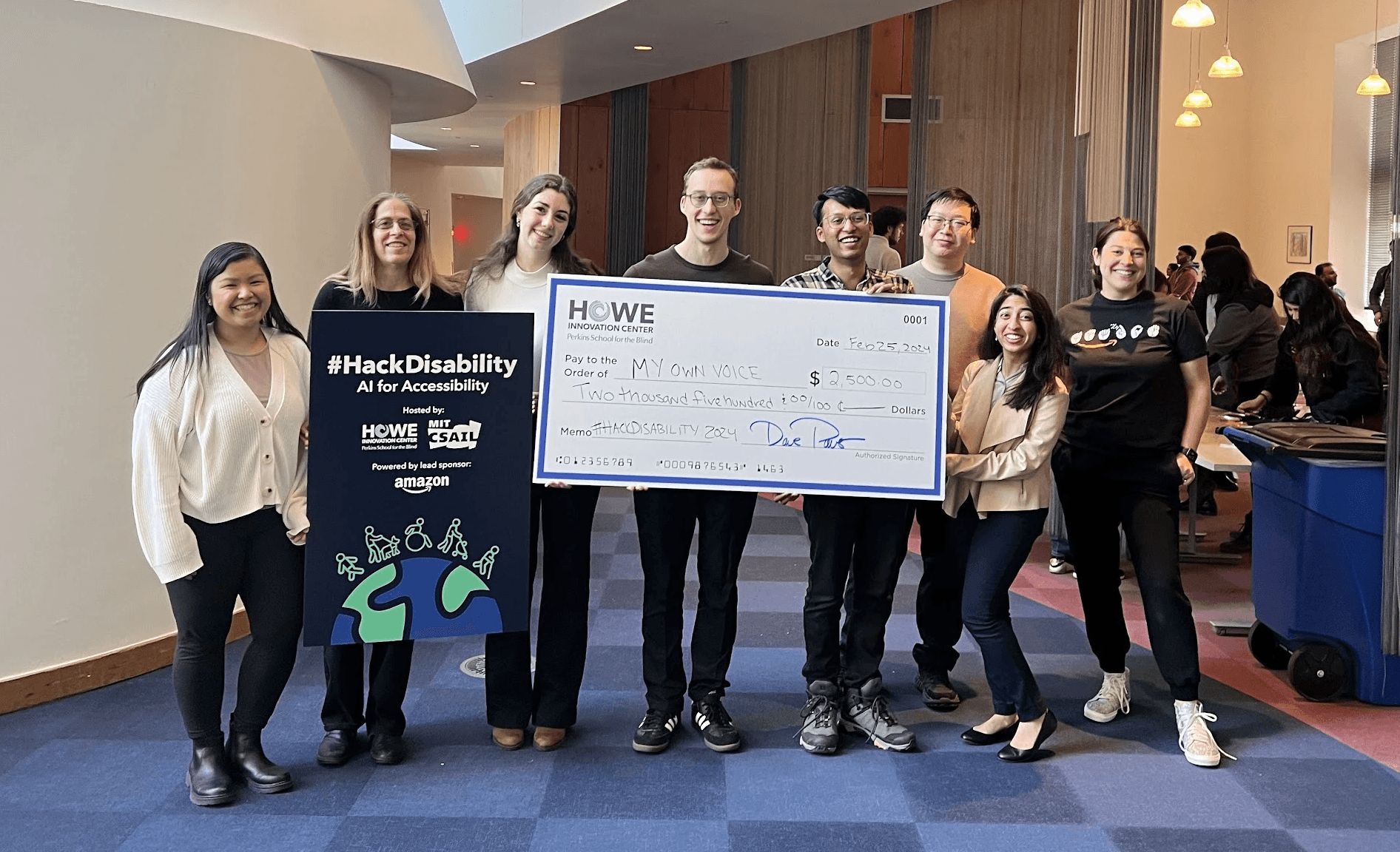
Prize winning personalized voice profile for Deaf and mute people.
UI Design
Overview
Client: MIT HackDisability Hackathon
Industry: A11y
Timeline: 3 days (February 2024)
My Role: User Experience Designer
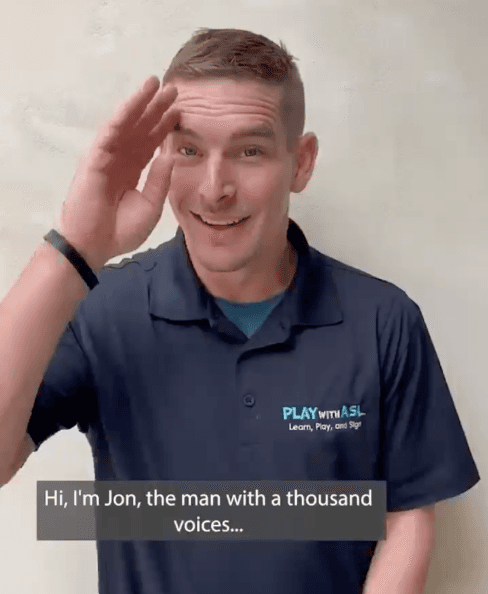
Existing text-to-speech solutions often lack the nuance required for personal identity, leaving Deaf, Hard of Hearing (HoH), and mute individuals with generic, robotic voices that do not reflect who they are. Inspired by Jon Mowl (the "Man of a Thousand Voices"), our team sought to solve the lack of personalized voice solutions when human interpreters are unavailable.
The Goal: Empower individuals to create a synthesized voice that truly reflects their unique identity.
The Challenge: Designing a customization interface that avoids acoustic terminology (pitch, tone) or rigid social binaries (gender, age) that may be alienating or conceptually abstract to the target user.
Skills
Core Methodologies
Subject Matter Expert Interviews
Rapid Concept Validation
User Journey Mapping
Design & Prototyping
UI Design
Wireframing
High-Fidelity Prototyping
Domain Knowledge
Deaf Culture & Communication
Accessible Design (a11y)
Physical/Digital Hybrid Experiences
Results
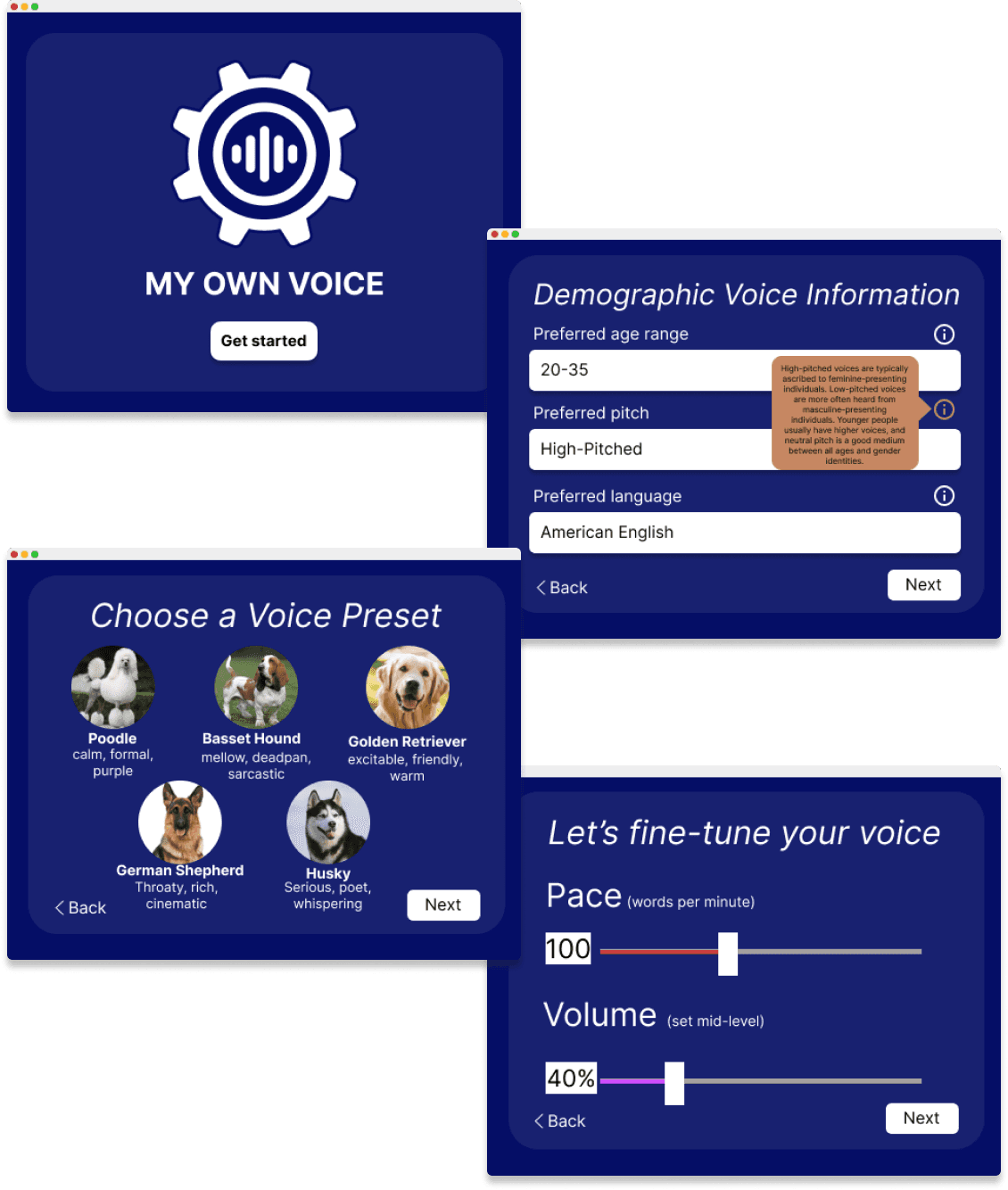
We delivered a high-fidelity concept for an accessible mobile application that reimagines how voice characteristics are categorized.
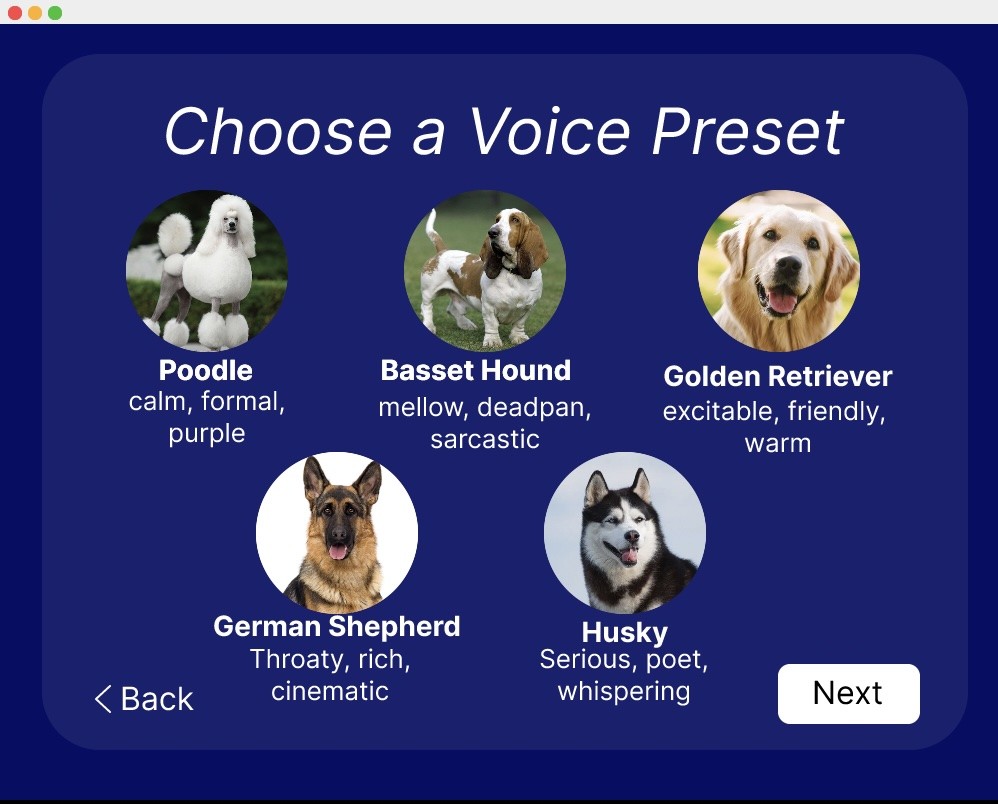
The "Dog Personality" Metaphor: We replaced exclusionary technical labels with a relatable, universal metaphor—dog breeds—to represent voice textures (e.g., a Golden Retriever for a warm, friendly voice vs. a Doberman for a sharp, authoritative voice).
Granular Customization: Beyond the base "personality," users can fine-tune specific attributes such as pace and volume to suit different contexts.
Impact: The solution provides an intuitive, non-binary framework that allows users to adopt a voice based on feeling and personality rather than acoustic capability.
The Process
Our approach was heavily research-led, focusing on deconstructing standard UX patterns that were inherently ableist.
1. Discovery & User Research To validate our assumptions, we conducted qualitative interviews with subject matter experts, including a Deaf woman and a Disability Accommodations Manager at a major tech company.
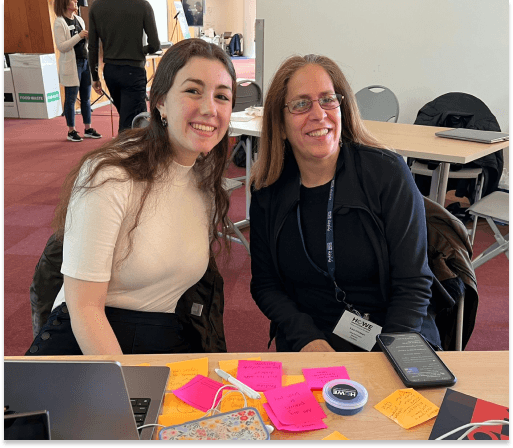
Me, post-interview with Lisa Chiango, an assistive tech specialist, who is DeafBlind. She shared so many experiences with me of being in the DeafBlind community and tips for AT.
2. Problem Definition & Insight Research revealed a critical flaw in current market solutions:
The Gap: Most tools ask users to adjust "Pitch," "Frequency," or select a gender/age.
The Friction: For individuals who are profoundly deaf, concepts like "pitch" are abstract and lack sensory reference. Furthermore, rigid gender/age labels can feel exclusionary to those who do not identify with traditional binaries.
The Pivot: We realized we needed a semantic way to describe sound, rather than an acoustic one.
3. Ideation & Solution Design We brainstormed metaphors that carried distinct "personality" traits without relying on sound or human demographics.
Testing: We tested various abstract concepts (colors, textures, animals).
Selection: The "Dog" metaphor resonated highest during testing. Dogs have distinct, culturally recognized personalities that are emotive and descriptive without being confined by human gender norms or acoustic technicalities.
Opportunities for Improvement & Expansion
Given more time and resources, I would expand the project scope to validate the product-market fit and technical feasibility:
Validation & Longitudinal Studies: While the hackathon allowed for rapid validation, I would invest in a longitudinal pilot program with a larger cohort of the Deaf community. This would help verify if the "dog metaphor" retains its usability over time or if it requires a secondary, more "professional" abstraction layer for workplace settings.
Technical Algorithm Mapping: I would work with engineering counterparts to define the precise mapping between the UI (Dog Avatars) and the backend TTS parameters (VoiceXML tags). We would need to determine exactly which acoustic variables (pitch, contour, timbre) map to "Golden Retriever" vs. "Pug" to ensure the output matches the user's expectation.
Business Case & B2B Integration: To build a sustainable business model, I would explore B2B integrations with major communication platforms (e.g., Zoom, Microsoft Teams). Pitching this as an accessibility plugin for enterprise clients would provide a clearer path to monetization than a standalone B2C app.